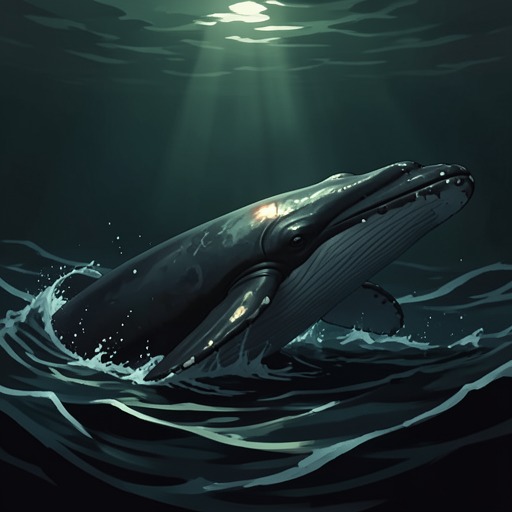
The White Color of Moby-Dick
The WhaleThe White Color of Moby-Dick is not simply a description of a whale’s appearance: it is a study of how whiteness gathers contradictory meanings around the unknown. In the account of Herman Melville’s novel, the pale whale can signify good and evil, purity and menace, while its colour also threatens to signify nothing at all. The sea and Arctic setting sharpen this paradox. They are real environments, with their own movements and inhabitants, but they also become spaces onto which human imagination projects what it cannot readily know.
A Colour Without a Settled Meaning
For Ishmael, whiteness is frightening not because it has one fixed meaning but because it can hold opposing ones. It may carry associations of innocence and goodness, yet it also belongs to creatures and images that inspire dread. The white bear of the polar regions and the white shark of the tropics make whiteness seem capable of heightening their strangeness. In this reading, the colour does not explain the whale; it makes the whale harder to interpret. Its smooth, pale surface can appear to offer a visible answer while withholding the certainty that colour usually promises.
The account stresses that Moby Dick is supposed to be an albino, an animal made unearthly by an absence of colour. That idea differs from the whiteness of the beluga whale, which is born grey and becomes white only in late adulthood. The distinction makes the white whale’s appearance more than a matter of natural description: it is a sign onto which observers place meanings. Moby Dick’s whiteness can therefore unsettle even when it seems to make the animal unmistakable. The whale is conspicuous, but what its conspicuousness means remains unresolved.
The Arctic as a Landscape of Extremes
The Arctic gives this ambiguity a setting. It is described as a dark place despite its whiteness: a region of six months of continuous night, extreme cold, and apparent emptiness, yet also one of the most abundant seas on earth. The same conditions appear to threaten life and sustain it. Snow may be deadly to the unprepared, while the waters support creatures stranger than fiction. The landscape resists a simple division between barren and fertile, lifeless and abundant, familiar and alien.
Its remoteness and seasonal cycles also shape how its whales are understood. Bowhead whales, belugas, and narwhals rise and fall with the changing ice; the text presents them as inhabitants of a bounded polar world, with the less numerous bowheads and narwhals seldom seen. These animals are not merely symbols: they belong to a real environment whose movements and limits matter. Yet their relative inaccessibility also makes them available to speculation. The Arctic’s apparent blankness invites stories, while its living abundance repeatedly exceeds what those stories can contain.
Whiteness, Storytelling, and the Unknown
Before the remaining wild places were mapped, storytellers filled fictional spaces on the map. The account describes imagined lands beyond a wall of ice, including an open sea where whales might find sanctuary from hunters. Such inventions do more than decorate a blank geography: they express desires about what the unknown might contain, including the hope that animals could escape human pursuit. But stories also borrow the authority of observation. An illustrated natural history could place a sea serpent among familiar polar animals, making the fabulous appear at home beside the documented.
This traffic between invention and supposed fact helps explain how the white whale becomes a symbol. The unknown is not simply left blank; it is populated by figures that carry human expectations and fears. In Melville’s novel, Ishmael’s expansive reflections on whiteness range from human figures to animals and fairy-tale apparitions. The movement does not settle the meaning of the whale. Instead, its accumulating examples show how interpretation circles around an object it cannot finally possess. Whiteness is at once a feature of the animal and an opening for projection.
The Sea Beyond the Map
The sea deepens the problem of representation. Henry David Thoreau describes it as a wilderness that has remained wild while cities and civilizations rise and fall. Its apparent constancy does not make it familiar: it remains vast, difficult to know, and present even at the edges of human settlements. Under observation, its surface changes continually, shifting from upheaval to stillness; what seems like an empty, seamless expanse may conceal lives and movements that are not visible from above.
The account’s description of the Azores offers a concrete counterpoint to the idea that maps make the ocean fully legible. These nine islands lie between Cape Cod and Lisbon, yet their visible points are the summits of immense submerged mountains, part of a geography mostly hidden beneath the surface. The sea is not empty simply because much of it cannot be seen. That tension between visible surface and concealed world echoes the whale’s whiteness: what appears clear or blank may mark the limits of human knowledge, not the absence of a reality beyond it. The pale whale consequently joins two kinds of unknowability—the animal that cannot be reduced to a human meaning and the ocean that cannot be reduced to a view.